Key facts
- The first Hindustani Scripture translations are credited to German missionary Benjamin Schultze, with parts published at Halle in 1745.
- Henry Martyn (1781 to 1812), a chaplain of the East India Company, translated the New Testament into Hindustani, now Urdu. It was printed at Serampore in 1814 for the British and Foreign Bible Society.
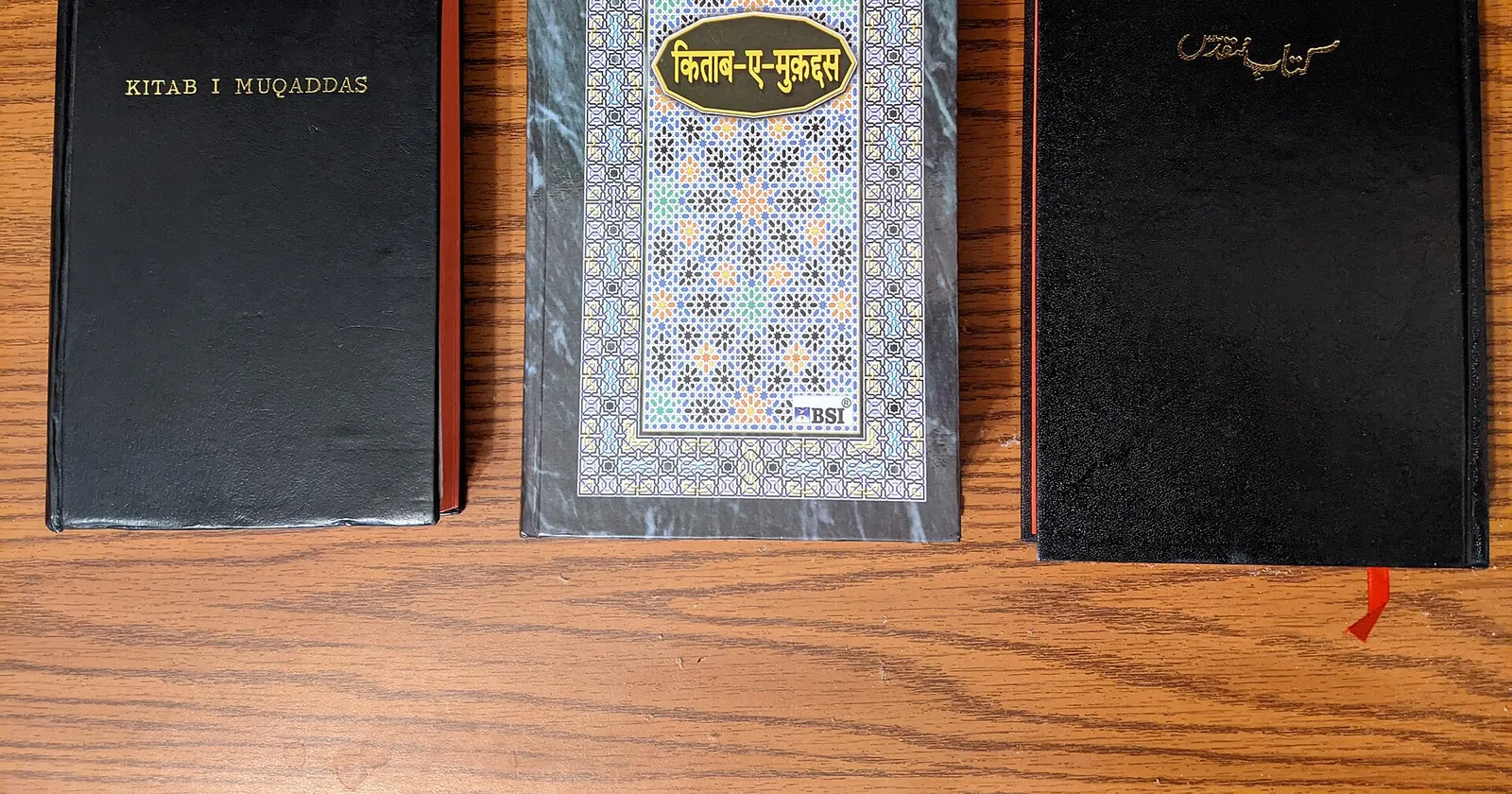
- The standard Protestant Urdu Bible in Pakistan is the Revised Urdu Bible (Kitab-e-Muqaddas), published by the Pakistan Bible Society.
- The Catholic Urdu Bible, Kalam-e-Muqaddas, was first published in 1958. A revised Catholic edition was launched in 2007.
- The Pakistan Bible Society’s work in Lahore dates to 1863. It became an independent society on 1 November 1967.
For most Christians in Pakistan, the Bible they read at home and hear in church is in Urdu. Its familiar words shape prayers, sermons, hymns and even everyday phrases in Christian homes. Yet few people know how the Bible came into Urdu, or who did the work.
This article traces that history, from the first Hindustani translations in the 18th century to the versions used in Pakistan’s churches today. It draws on library records, Bible Society sources and church news reports.
Who first translated the Bible into Urdu?
Urdu and Hindi grew from a shared spoken language, long called Hindustani. The earliest Bible translations into this language were made in South India, not in the north.
Benjamin Schultze (1689 to 1760), a German missionary who arrived in India in 1726, worked with the Danish mission at Tranquebar. He translated parts of the Scriptures into the Deccani form of Hindustani. Parts of Genesis were published at Halle in Germany in 1745, together with a grammar. A British and Foreign Bible Society catalogue describes his version as the earliest Hindustani Scripture, made about the middle of the 18th century.
Schultze’s work was a beginning, but it was in the southern Deccani dialect. The Urdu used across northern India, including the region that became Pakistan, needed its own translation.
Henry Martyn and the 1814 Urdu New Testament
That translation came from Henry Martyn. Born in Truro, Cornwall, in 1781, he went to India as a chaplain of the British East India Company and arrived in 1806. Alongside his chaplaincy he worked intensely on languages.
Martyn translated the whole New Testament into Hindustani, now Urdu, and also produced the first Persian New Testament. Cambridge University Library holds a manuscript copy of his Urdu New Testament, its binding marked “New Testament in Hindoostanee by Rev. H. Martyn”. Its catalogue records that the translation was published at the Serampore Mission Press for the British and Foreign Bible Society in 1814.
Martyn did not see his Urdu New Testament in print. He died on 16 October 1812 at Tokat, in what is now Turkey, aged 31. Later translators revised and built on the Hindustani Scriptures of this period.
From Hindustani to Kitab-e-Muqaddas
During the 19th century, Hindustani Scriptures were printed and reprinted in Kolkata, Madras and Mirzapur, and new editions continued to appear as the language itself changed.
The version used most widely in Pakistan today is the Revised Urdu Bible, known by its Urdu title Kitab-e-Muqaddas (the Holy Book). It is translated from the Hebrew, Aramaic and Greek texts and is published by the Pakistan Bible Society and the Bible Society of India. It has received several minor revisions over the decades, and the Pakistan Bible Society’s current edition is also available free online through the YouVersion Bible app.
Other Urdu translations have appeared more recently, including the Urdu Geo Version, a fresh translation from the original languages published in 2011, and Urdu New Testaments produced by Biblica.
The Catholic Urdu Bible: Kalam-e-Muqaddas
Pakistan’s Catholic Church uses its own edition. It was first published by the Pakistan Bible Society for the Catholic Bible Commission in 1958, under the title Kalam-e-Muqaddas.
A major revision followed. AsiaNews reported that work began in April 2002 under the Catholic Bible Commission, led by Archbishop Evaristo Pinto of Karachi and Emmanuel Asi. The new edition was presented on 29 July 2007 at a Mass led by Bishop Joseph Coutts of Faisalabad. It replaced archaic words that readers had asked to modernise for some 25 years, cut the length from 1,665 to 1,455 pages and added five colour maps. The Pakistan Bible Society printed and published it.
The Pakistan Bible Society
Behind almost every Urdu Bible in Pakistan stands the Pakistan Bible Society, based at Bible House in Anarkali, Lahore. Its work traces back to 1863, when a Punjab auxiliary of the British and Foreign Bible Society began in Lahore. It has been independent since 1 November 1967.
In 2013 the society marked 150 years of Bible work. On 9 February that year it opened a Bible Museum at Bible House, with replicas of ancient manuscripts and archaeological objects. Later that year it displayed a giant handwritten Urdu Bible. Christian Today reported that 41 volunteers wrote it by hand over about three years. Each page measures 23 by 36 inches and the book weighs around 90 kilograms.
The handwritten Bible was the idea of the society’s general secretary, Anthony Lamuel. It is kept on display at Bible House and is not for sale.
Where to read or buy an Urdu Bible today
Readers have more options than ever. The Revised Urdu Bible can be read free on the YouVersion Bible app, which lists the Pakistan Bible Society as its publisher. Readers who want a printed copy are directed to contact the society, whose Bible House is in Anarkali, Lahore.
For researchers, historic copies are held in libraries abroad. Cambridge University Library, for example, keeps a manuscript copy of Henry Martyn’s Urdu New Testament in its archives. Catholic readers can ask their parish or diocese for the Kalam-e-Muqaddas edition approved by the Catholic Bible Commission.
Urdu Bible timeline
| Year | Milestone |
|---|---|
| 1745 | Parts of Schultze’s Hindustani Genesis published at Halle |
| 1806 | Henry Martyn arrives in India as an East India Company chaplain |
| 1814 | Martyn’s Urdu New Testament printed at Serampore for the BFBS |
| 1863 | Bible Society work begins in Lahore (Punjab auxiliary) |
| 1958 | Catholic Urdu Bible, Kalam-e-Muqaddas, first published |
| 1967 | Pakistan Bible Society becomes independent (1 November) |
| 2007 | Revised Catholic Urdu Bible launched (29 July) |
| 2011 | Urdu Geo Version published |
| 2013 | Bible Museum opens in Lahore for 150 years of Bible work |
Why the Urdu Bible matters to Pakistani Christians
Urdu is Pakistan’s national language. Having the Scriptures in Urdu lets Christians read for themselves, teach their children and follow the readings in church.
The Urdu Bible also links faith and literacy, because a Bible in the home is only useful to those who can read it. Our article on the Christian literacy rate in Pakistan looks at that gap in detail.
How CSIF connects to this work
CSIF is not a Bible publisher, and we do not translate or distribute Scripture. Our work starts where literacy opens doors: digital skills, business training and support for young founders and women in Rawalpindi and Islamabad. Through Church Tech Enablement, we help congregations use simple digital tools for communication, records and outreach.
To learn about the churches where Urdu Scripture is read every week, see our guide to famous churches in Pakistan. Churches and foundations abroad who want to support this work can partner with us.